
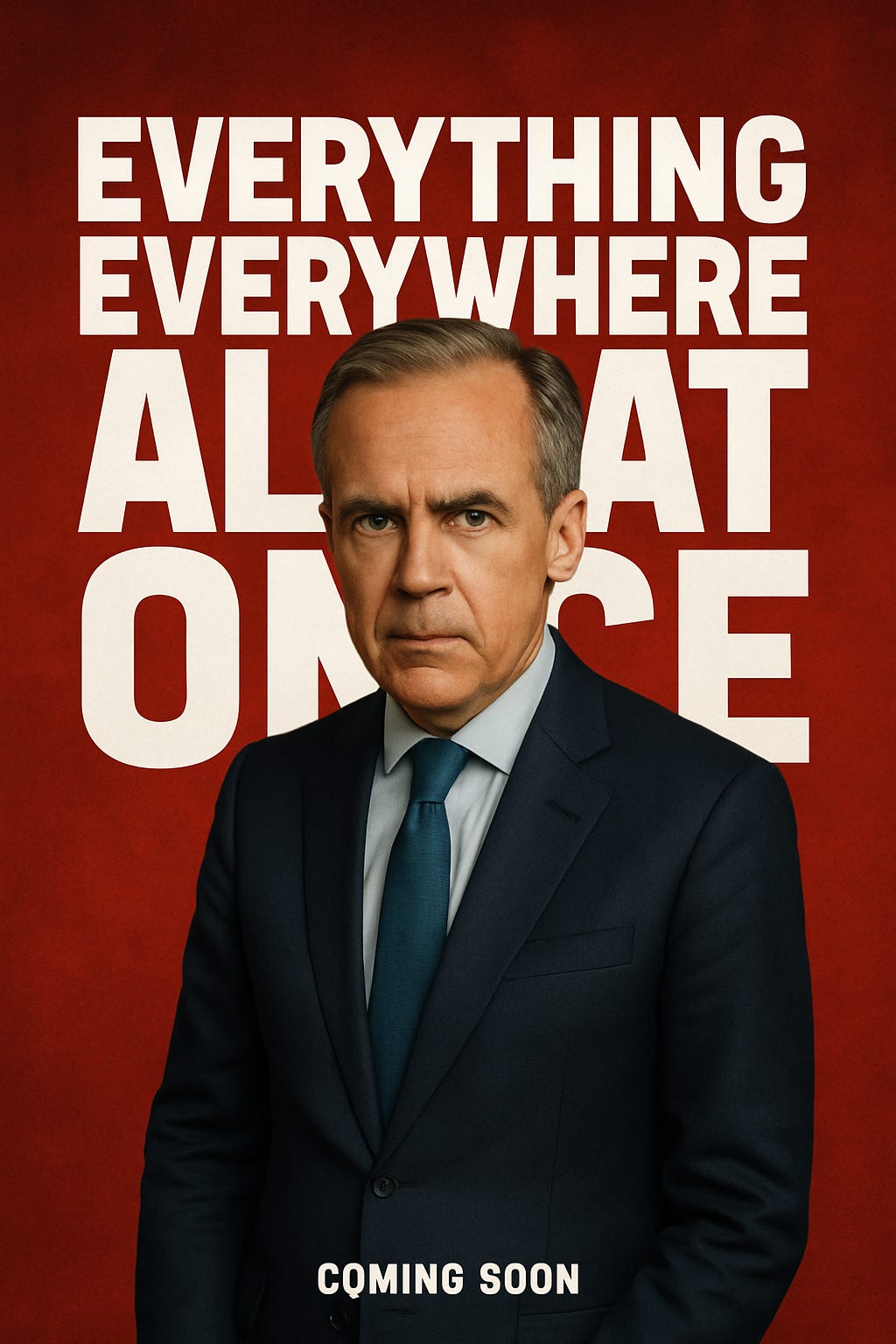
Everything everywhere all at once

Every Prime Minister has their defining first act.
Jean Chrétien had program review. His government restructured the federal budget from the ground up, asking fundamental questions about what government should do and how. Stephen Harper had the Economic Action Plan, launched in response to the global financial crisis. Justin Trudeau’s first term was consumed by the renegotiation of NAFTA, a trade fight that tested the Canada–US relationship in new and unpredictable ways.
Mark Carney is going to take on all three. At once. And it hasn’t even been six months.
This fall, the government is stepping into a perfect storm of policy battles. The scale of the challenge is staggering. Any one of these fights would be enough to define a four-year mandate. Together, they represent something more ambitious, more dangerous, and possibly more consequential than anything Ottawa has seen in a generation.
It is, quite literally, everything everywhere all at once. The film of the same name followed an overburdened woman trying to survive collapsing timelines and infinite versions of herself, each facing existential crisis. That feels about right. Except in this version, the multiverse is made up of legacy programs, draft legislation, and competing global priorities.
Start with program review. It’s long overdue. Canada’s federal spending has ballooned over the past decade, accelerated by the pandemic and prolonged by political inertia. The need for a thoughtful review is clear. But that kind of review is hard. Chrétien and Martin didn’t just ask departments to trim the fat. They asked whether programs should even exist. They forced ministers to defend each line item. They made hard choices and stuck to them.
I don’t even need to mention the impending fight with the public service unions. That is inevitable. What isn’t inevitable is that it will work. The risk right now is that government will take the path of least resistance. That means spreading the cuts evenly across every program. It’s easy and safe. But it’s not strategic. Lean programs will get cut. Fat programs will get trimmed. Nothing gets prioritized. Everything gets preserved in miniature.
That’s not what this moment calls for. For what it is worth, the Prime Minister seems to want a real program review. That means ministers and their staff will need to be active drivers of the process. They will need to set priorities, force decisions, and make value judgments. They cannot outsource this to the centre. They cannot delegate it to the public service. Otherwise, the result will be a hollow exercise that saves little and changes nothing.
Then there is Bill C-5. The legislation is framed as an effort to accelerate the approval of major projects. This is not a popular comparison in Liberal circles, but early indications somewhat echo the Harper government’s approach to major project approvals in his first term. While the full regulatory overhaul came later, Harper’s early push for central coordination, the creation of the Major Projects Management Office, and efforts to streamline environmental reviews all set the stage. The same issues around jurisdiction, consultation, and delay were front and centre, and Indigenous consultation quickly became a flashpoint.
C-5 appears to be walking into the same minefield. The early reaction from Indigenous leadership has been mixed at best. Opposition parties are sharpening their lines. This is not a quiet policy tweak. It could very well be a national showdown in the making.
On top of that, the Canada–United States trade relationship is once again in crisis mode. Carney’s government is not backing down, and neither is the Trump administration. Sound familiar? Unfortunately, we have seen this movie before. Trudeau’s first government spent years in the trenches over NAFTA renegotiation. Now the sequel is here, with a few different characters and a broader stage.
But the list doesn’t stop there. Canada is also in the early stages of the most significant military rearmament since the Second World War. Billions will need to be spent. Procurement decisions will be scrutinized. Domestic industry will want a piece. Allies will expect clarity and urgency. All of this is happening in a fiscal environment that is tightening by the day. And hovering over everything is the looming spectre of stagflation. Many economists are worried about an economic slowdown that comes with high prices and higher interest rates.
This is a full agenda. No one can deny that. But it’s more than that. It’s a dangerous mix of political risk. There’s very little room for error. Each file brings its own set of stakeholders, constraints, and tripwires. Each one would be difficult to manage in isolation. Together, they create a gravitational pull that could define the Carney government for better or for worse.
At least Everything Everywhere All at Once had a talking raccoon and hot dog fingers to lighten the mood. Ottawa’s version just has program review spreadsheets and trade lawyers.
The upside is real. If this government can pull it off, they will have future-proofed the role of the state, revitalized economic growth, modernized the regulatory landscape, rearmed the military, and redefined Canada’s place in the global order. That is a legacy that would rival any modern Prime Minister. Maybe any Prime Minister ever.
But the road from here to there is steep and full of hazards. Political capital is finite. Time is short. Fall is coming.
And this government is trying to do everything everywhere all at once.