
An accidental election?

On December 13, 1979, Joe Clark’s government fell after failing to pass its budget. It wasn’t supposed to happen. Clark miscounted the votes, and Canadians found themselves in an accidental election.
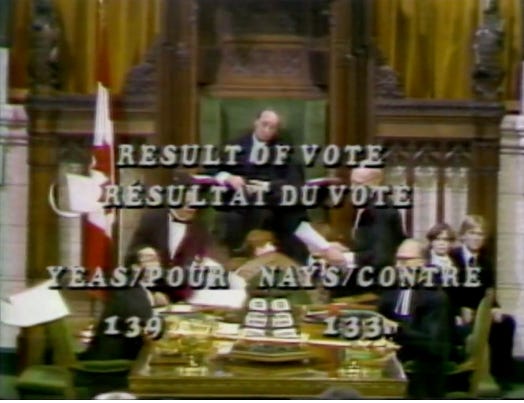
Forty-six years later, the math in Ottawa looks strangely familiar.
The difference this time is that almost nobody actually wants an election. The Conservatives and the NDP have more to lose than gain. The Bloc clearly want one. The government doesn’t, but let’s be honest, they wouldn’t exactly cry about it either. If the polls stay the same, an “accidental” election might not look so bad from the Prime Minister’s Office.
That’s especially true if Mark Carney decides he’s had enough of governing with one hand tied behind his back. A minority can survive gridlock for a while, but not a Prime Minister with a full legislative agenda and no reliable partners.
I don’t expect history to repeat itself. But it’s worth remembering there’s no such thing as a strong or stable minority. They all collapse eventually, mostly by choice but sometimes by mistake.
Pierre Poilievre is facing a leadership review in the New Year. He’s not expected to lose, but between now and then he has to look firmly opposed to the government’s upcoming budget. He can’t afford to look accommodating. With virtual voting, the old trick of a few opposition MPs quietly missing a confidence vote doesn’t work the way it used to. Everyone has to show up, whether in person or online. I’m pretty sure every MP has home internet, which makes it pretty difficult to hide.
The Bloc Québécois have released a list of six budget demands that appear designed to provoke a rejection. In previous parliaments, their proposals were more grounded in political reality. This time, the demands suggest a preference for triggering an election ahead of a Quebec provincial vote that will put sovereignty at the forefront of the ballot box issues.
The NDP are in the middle of a leadership race that’s turning into a fight for the party’s progressive soul. Many of their MPs don’t want to be seen propping up a centrist government. Each vote becomes a loyalty test, and every compromise risks being weaponized inside their own party. In that kind of atmosphere, discipline is hard to maintain and cooperation even harder.
And then there’s the government itself. Its support is still solid. Even if some national polls look slightly tighter, regional numbers suggest a majority’s still within reach. The Prime Minister’s personal ratings are very strong and continue to pull the Liberal brand up with them.
The numbers are good, but good polling numbers can’t move legislation. If Mark Carney finds himself spending more time negotiating than governing, he may decide an early election is worth the risk. The government’s legislative agenda is just getting started, but it doesn’t control a single House committee. The Bloc and the Conservatives hold the balance of power on every single one of them. The NDP don’t even have a seat, which means they can’t be the government’s dance partner, and even if they could they probably don’t want to be. Every bill will hit procedural quicksand. Committees will soon be a kind of legislative Alcatraz. Few bills will escape, and the ones that do will come out looking like they tunneled through with a spoon.
The budget will be introduced on November 4, and if all goes according to plan, the Budget Implementation Act will pass before Christmas, almost exactly on the anniversary of Clark’s downfall. Again, I don’t think history is about to repeat itself, but you have to admit that there’s a strange symmetry here.
Only the Bloc seems eager for an election. The government would prefer to avoid one, even if it wouldn’t see it as a disaster. The Conservatives and the NDP don’t want an election either, but the politics are awkward. They can’t look weak, and they can’t look like they’re helping the government. That’s how you end up in an election nobody meant to have. A misstep, a miscount, or a single moment of stubbornness could send the country back to the polls before anyone’s ready.
Minority governments are often a political game of chicken. To avoid an election, someone will need to blink. I just don’t know who it will be.